What Is a DRHP? A Definitive Guide for Companies Preparing to File

A DRHP (Draft Red Herring Prospectus) is the first full disclosure document a company files with SEBI (or, for an SME IPO, with the stock exchange) before it can offer shares to the public. It describes the business, its finances, its risks and the offer, and the regulator and the public can comment on it before it is finalised.
Filing volumes have stayed high through 2026, and SEBI publishes a weekly processing status report showing how many drafts are waiting for review. More filings usually mean more drafts in the same queue, so a draft that needs fewer rounds of questions generally clears sooner.
In this guide
This guide is written for promoters, CFOs and company secretaries who expect to file in the next year or two. It covers what the document is, whether your company can file one, what goes inside it, who prepares it, and where drafts can get held up.
What a DRHP is
The rules for a DRHP come from the SEBI (Issue of Capital and Disclosure Requirements) Regulations, 2018, usually shortened to ICDR. Chapter II covers mainboard IPOs and Chapter IX covers SME IPOs.
It is called a draft because it can still change. SEBI (or the exchange, for SME issues) reviews it, members of the public can send comments, and the company then has to carry the resulting changes into later versions of the document.
The “red herring” part refers to the price. A DRHP does not state the price at which shares will be sold, so it cannot be used to sell them. The name carries through to the next stage too: the Red Herring Prospectus (RHP) is also unpriced. Only the final Prospectus, filed after the issue closes, carries the price.
An analogy that might help: a DRHP works a bit like the drawings a builder submits to the local authority before construction starts. The authority can ask for changes, and the building that goes up has to match the approved drawings. If the drawings are wrong to begin with, each later stage tends to inherit the problem.
How the DRHP connects to the RHP and the Prospectus
A company usually files several versions of its offer document on the way to listing, and each one builds on the one before it.
| Document | When it is filed | Who can read it | Priced? |
|---|---|---|---|
| DRHP | First filing, with SEBI and the exchanges (or the exchange alone for SME) | Public, for comments | No |
| UDRHP | After SEBI’s observations and public comments | Public | No |
| RHP | With the Registrar of Companies, shortly before the issue opens | Public | No (the price band is announced separately) |
| Prospectus | After the issue closes | Public | Yes |
On the confidential pre-filing route (covered further down), the first filing stays private and there are two updated drafts, UDRHP-I and UDRHP-II, before the RHP.
Since 21 March 2026, companies also file a draft abridged prospectus along with the DRHP. It is a shorter summary for retail investors, hosted next to the DRHP during the comment period, so it travels with the draft and does not count as a separate stage.
For the company, the main point is that every later document is built on the DRHP. A figure that is wrong in the draft, or a disclosure that is missing, usually has to be corrected in each version that follows, and each correction is one more item for the team to track.
Mainboard or SME: who reviews your draft
For a mainboard IPO, the DRHP goes to SEBI and the stock exchanges, and SEBI reviews it and issues observations.
For an IPO on an SME platform such as BSE SME or NSE Emerge, the draft is filed with the exchange under Chapter IX. Regulation 246(2) of ICDR provides that SEBI does not issue observations on SME offer documents, so the review sits with the exchange.
Since SEBI’s March 2025 changes to the SME framework, SME drafts also have to stay open for public comments for 21 days, with a newspaper announcement carrying a QR code that links to the document.
It helps to settle the route early, because the eligibility tests and the promoter lock-in rules are different for each, as the next section shows.
Can your company file? Eligibility and promoter commitments
Before any drafting starts, it is worth checking which route your company qualifies for. The tests below summarise the main conditions and are not a complete list, so your lead manager and legal counsel will usually run a full eligibility check as well.
Mainboard: Regulation 6(1) and 6(2)
Regulation 6(1) is the profitability route. All figures are calculated on a restated and consolidated basis, and the company has to meet each of these conditions:
- Net tangible assets of at least ₹3 crore in each of the preceding three full years, with no more than 50% held in monetary assets (this cap does not apply if the IPO is entirely an offer for sale).
- Average operating profit of at least ₹15 crore over the preceding three years, with an operating profit in each of those years.
- Net worth of at least ₹1 crore in each of the preceding three years.
- If the company changed its name in the last year, at least 50% of its revenue in the previous full year has to come from the activity the new name suggests.
A company that does not meet these conditions can still list on the mainboard under Regulation 6(2). The trade-off is that at least 75% of the net offer has to be allotted to qualified institutional buyers, which leaves a smaller portion for retail investors.
Regulation 5 adds general conditions that apply on either route. For example, the company, its promoters and its directors cannot be debarred by SEBI, and promoters and directors cannot be wilful defaulters or fugitive economic offenders.
One practical detail: the three-year window moves forward with each financial year. A company that misses 6(1) because of one weak year may qualify once that year drops out of the window, so the timing of the filing can change the route, and with it the share of the issue open to retail investors.
SME platforms
The SME tests were tightened in March 2025. The main ones are:
- Operating profit (EBITDA) of at least ₹1 crore in two of the last three financial years.
- An offer for sale capped at 20% of the issue size, and no selling shareholder can sell more than 50% of their holding.
- Money for general corporate purposes capped at 15% of the amount raised or ₹10 crore, whichever is lower.
- IPO proceeds cannot be used to repay loans from promoters, the promoter group or related parties.
Minimum promoter contribution and lock-in
This is often the first question promoters ask, so it helps to settle it early.
Promoters have to hold at least 20% of the company’s post-issue capital (Regulation 14 for the mainboard, Regulation 236 for SME). Only shares that pass the eligibility tests in Regulation 15 (Regulation 237 for SME) count towards this 20%. Some recently issued bonus shares, or shares bought below the IPO price within a set period before filing, can fail those tests, so promoters sometimes find they hold less eligible stock than they expected. The requirement does not apply where a company has no identifiable promoter.
The shares are then locked in, which means they cannot be sold or transferred for a set period, starting from the IPO allotment date. On the mainboard, the longer periods apply where most of the fresh issue proceeds (leaving out the offer for sale) go towards capital expenditure, and repaying loans taken for capital expenditure counts towards that:
| Holding | Mainboard (standard) | Mainboard (objects mainly capital expenditure) | SME |
|---|---|---|---|
| 20% minimum contribution | 18 months | 3 years | 3 years |
| Promoter holding above 20% | 6 months | 1 year | Half released after 1 year, half after 2 years |
| Other pre-issue shareholders | 6 months | 6 months | 1 year |
Since the March 2026 amendment, if a pre-issue shareholder’s shares are pledged and cannot be locked in the usual way, the depositories record them as non-transferable for the lock-in period instead. If your shareholders include lenders or investors holding pledged shares, it is worth raising this with your lead manager before the capital structure section is drafted.
What goes inside a DRHP
The contents are set out in Schedule VI of ICDR. A mainboard DRHP often runs to several hundred pages and broadly covers the business, the financials, legal matters and the terms of the offer.
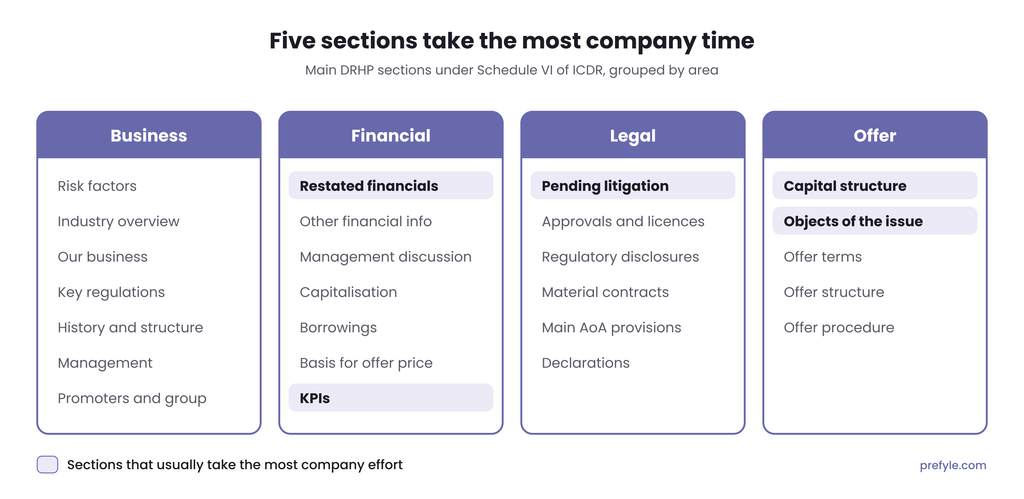
Some sections take far more of the company’s time than others. These are usually the heavy ones:
Capital structure. The full history of every share allotment and transfer, often back to incorporation. The team has to produce the allotment records, the RoC filings for each allotment and the transfer documents. Gaps from years back (a form that was never filed, a board resolution nobody can find) tend to surface here.
Financial information. Restated financial statements, management’s discussion and analysis, the capitalisation statement and details of borrowings. The auditors prepare the restatement, but the finance team usually has to explain each significant movement and reconcile any figure that appears elsewhere in the document.
Outstanding litigation. Cases involving the company, its directors, promoters and group companies, tested against a materiality policy the board approves. Litigation records kept by different people (in-house legal, finance, the promoters’ own advisers, etc.) often do not line up, so this section can take longer than expected.
Objects of the issue. What the money raised will be used for. Where it funds capital expenditure, the company generally needs quotations or estimates to back each amount.
Basis for offer price and KPIs. The key performance indicators that support the valuation. Since 1 April 2025, KPI disclosures follow industry standards SEBI issued in February 2025, and KPIs the company has shown to pre-IPO investors usually need to appear in the DRHP as well.
What changed in 2026
The SEBI (ICDR) (Amendment) Regulations, 2026 took effect on 21 March 2026. They removed the “Summary of the offer document” chapter and introduced a draft abridged prospectus, prepared under Part E of Schedule VI, which is filed with the DRHP and hosted on the websites of SEBI, the exchanges, the company and the lead managers.
SEBI set out its reasoning in a consultation paper dated 13 November 2025. Offer documents had grown long enough to put off retail investors, and very few people sent comments on drafts, even though each one was open for at least 21 days. A shorter, standard summary is meant to make the draft easier to read and to comment on.
Who prepares it, and what your team does
A DRHP is drafted by a group of advisers, led by the book running lead managers (merchant bankers registered with SEBI). They run the process, write much of the document, carry out due diligence and sign a due diligence certificate that goes to SEBI with the filing.
Around them sit legal counsel (usually one firm for the company and another for the lead managers), the statutory auditors and a peer-reviewed chartered accountant who certify the financials and many of the figures, an industry research firm that writes the industry report, the registrar to the issue, and the company secretary.
The company’s own team generally carries more of the load than founders expect. In practice, that means pulling records going back several years, answering due diligence questions from each adviser (often the same question in slightly different forms), arranging board and shareholder approvals, and checking that a figure reads the same way in every section where it appears.
In practice, it usually takes about three to six months from the lead managers coming on board to filing the DRHP for a mainboard IPO, and about two to four months for an SME IPO. The review by SEBI (or the exchange) and the listing come after that.
Where a company lands in that range mostly depends on how ready it is. A company that is already a public limited company, with its records in order and auditors and lawyers who can get what they need quickly, is usually nearer the shorter end. A company that still has to convert, dig up old records, update its financials or fix gaps in filings or litigation disclosures can take longer.
Two things often hold up the filing: getting the restated financials signed off, and resolving issues that come up in legal due diligence. Fairly small gaps can cause the delay, such as missing audit schedules, needing a fresh set of interim numbers, or tracking down the paperwork for an old share allotment. Starting the record-gathering early can shorten this, because finding the documents is often slower than writing about them.
From filing to listing
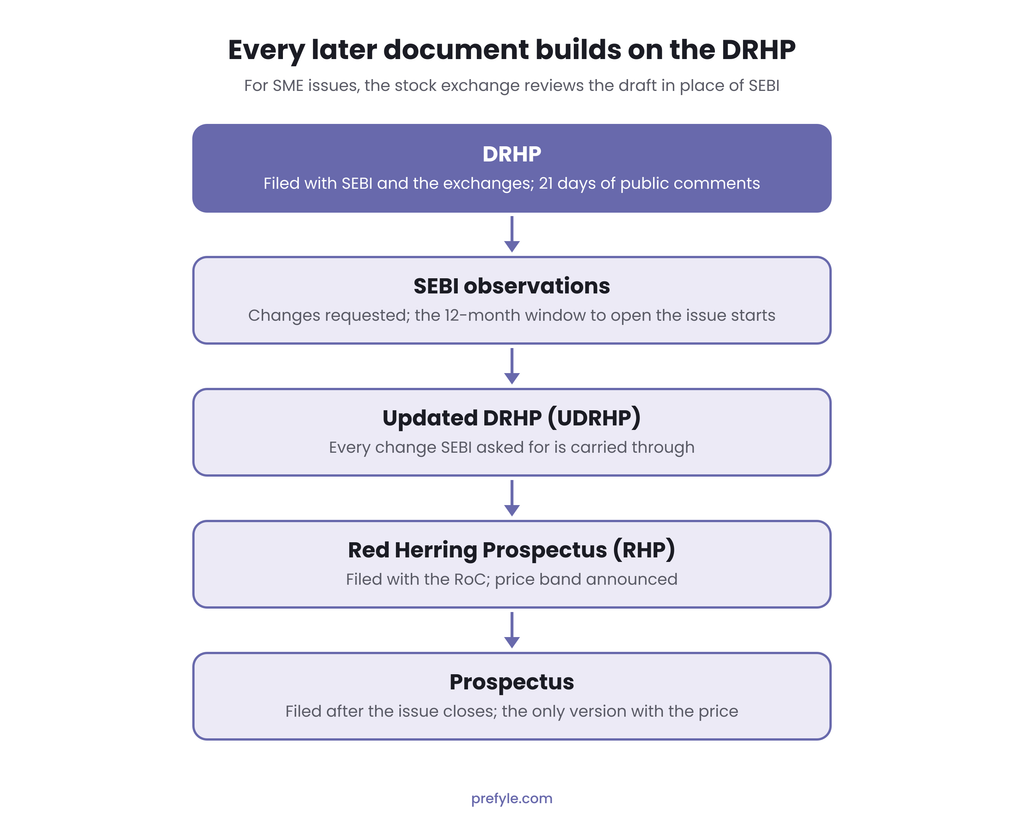
- The board and shareholders approve the issue, the company appoints its advisers, and due diligence begins.
- The company files the DRHP and the draft abridged prospectus with SEBI and the stock exchanges.
- Within two working days of filing, the company publishes a public announcement in one English and one Hindi national daily and in a regional daily. The draft is then open for public comments for 21 days.
- The exchanges grant in-principle approval. SEBI raises queries with the lead managers and then issues its observations.
- The company files an updated DRHP that carries through every change SEBI asked for.
- The RHP is filed with the Registrar of Companies, the price band is announced, and the lead managers run roadshows and allocate shares to anchor investors.
- The issue opens for at least three working days. After it closes, the company files the Prospectus, shares are allotted, and trading begins.
How long SEBI takes can vary a lot. One company that filed on 19 December 2025 received its observations on 11 March 2026, a little under three months later. Another filed on 12 June 2025 and received observations on 10 March 2026, about nine months later.
Once SEBI issues observations, the issue has to open within 12 months (Regulation 44), or within 18 months on the confidential route. If the window passes, the company generally has to file again.
SEBI does adjust these timelines from time to time when markets are difficult. In a circular dated 7 April 2026, it extended observation letters due to expire between 1 April and 30 September 2026 so that they stayed valid until 30 September 2026. That was a one-time measure, and we have not seen it renewed. A separate relaxation on changing the size of the fresh issue, which SEBI communicated to the Association of Investment Bankers of India on 12 October 2026, now covers issues opening on or before 31 March 2027 (see the FAQ below). If your timeline sits close to either date, it is worth checking SEBI’s latest circulars with your lead manager.
The confidential pre-filing route
Since late 2022, mainboard issuers have had a second option under Chapter IIA of ICDR. The company pre-files its DRHP with SEBI and the exchanges privately, so the document itself does not become public at that stage. The company does still have to announce that it has pre-filed.
After SEBI’s observations, the company files UDRHP-I, which is public and open for 21 days of comments, then UDRHP-II, and then the RHP. If the company decides not to go ahead, its detailed business information never enters the public domain, which can matter for companies in competitive markets. It also gets 18 months from SEBI’s final observations to open the issue, compared with 12 months on the standard route.
Tata Play was the first company to use the route in 2022, and companies including PhysicsWallah and boAt’s parent, Imagine Marketing, have used it since. SEBI’s listing of draft offer documents marks pre-filed documents, so you can see how often the route is being used at any time.
Schedule XVI-A rather than Schedule XVI governs changes to the offer on this route, and some of its thresholds are higher, so it is worth asking your lead manager which set of rules applies at each stage.
Why drafts get returned or delayed
SEBI can return a DRHP when it finds material non-compliance or incomplete disclosure. A returned draft usually has to be corrected and filed again, which restarts the review. SEBI lists returned and withdrawn documents in its processing status data, so a return is visible to anyone following the market.
The causes that come up often are fairly ordinary:
- A revenue or customer figure in the business section that does not match the restated financials.
- A case that turns up late in due diligence and is missing from the outstanding litigation section.
- A gap in the share capital history, such as an allotment from years ago with no matching RoC filing.
- Objects of the issue described so loosely that SEBI cannot tell what the money will fund.
- KPIs in the DRHP that differ from what pre-IPO investors were shown.
A comment can also cause trouble well after the draft clears. In January 2026, SEBI fined Gretex Corporate Services, a merchant banker, ₹15 lakh for several lapses (adjudication order Order/AK/GN/2025-26/31964, as disclosed to NSE). One of them was not making changes SEBI had asked for in an observation letter dated 18 January 2024. The penalty fell on the banker, but the change that was missed sat in the company’s own offer document, and it is usually the company’s team that supplies the corrected figures. Every change SEBI asks for has to be carried into the RHP, so a draft with fewer comments usually means fewer changes to track, and fewer chances to miss one.
These problems usually start in the company’s records and data, which means they can often be caught months before anyone writes the first chapter.
A preparation checklist for the 12 to 18 months before filing
None of this needs a lead manager to start. Your company secretary and finance team can usually work through it in parallel:
- Convert to a public limited company if you have not already. This often takes longer than founders expect.
- Move all promoter shares into demat form (Regulation 7(1)(c)).
- Make sure all shares are fully paid up, or that partly paid shares have been dealt with (Regulation 7(1)(d)).
- Convert or settle outstanding convertible securities such as CCPS, warrants or convertible notes. A company with outstanding convertibles generally cannot file a DRHP (Regulation 5(2)), although some, like employee stock options, are exempt.
- Check which promoter shares count towards the 20% minimum contribution.
- Complete and reconcile statutory registers and RoC filings.
- Keep share allotment, transfer and ESOP records in one place.
- Have audited financials for the look-back years ready, and brief the auditor on the restatement.
- Build one litigation register covering the company, directors, promoters and group companies.
- List licences and approvals with their expiry dates, and review material contracts and related party transactions.
- Agree KPI definitions internally and use them the same way in investor decks.
- For an SME IPO, plan for a market maker for at least three years after listing (Regulation 261).
Once most of this is in place, choosing between the mainboard and an SME platform, and then approaching lead managers, tends to go faster, because the first round of due diligence has fewer gaps to chase.
Where Prefyle fits
Prefyle is an AI-powered drafting and compliance tool for merchant bankers and IPO teams. It helps draft DRHP chapters and check them against ICDR requirements, which is where problems like figures that do not match between sections, or changes that were not carried through, tend to show up. If you are preparing a DRHP, you can request a demo, or ask about our design partner programme.
Common questions
What is the full form of DRHP?
DRHP stands for Draft Red Herring Prospectus. It is the first version of the offer document a company files before an IPO.
Is a DRHP the same as SEBI approval?
No. Filing a DRHP starts the review. SEBI issues its observations after the review, and the company then has 12 months to open the issue (18 months on the confidential route).
How long does SEBI take to review a DRHP?
It varies. Recent cases range from a little under three months to about nine months between filing and observations, depending largely on how many queries SEBI raises and how quickly they are answered.
How long does it take to prepare a DRHP?
Usually about three to six months for a mainboard IPO and two to four months for an SME IPO, counted from when the lead managers come on board to when the DRHP is filed. Companies with clean records and signed-off financials tend to be at the shorter end.
What is the difference between a DRHP and an RHP?
The DRHP is the first draft, filed for review and public comments. The RHP is filed with the Registrar of Companies just before the issue opens, after SEBI’s changes have been made. Neither carries the final price.
Does an SME DRHP go to SEBI?
An SME DRHP is filed with the stock exchange under Chapter IX of ICDR, and SEBI does not issue observations on it (Regulation 246(2)). The exchange reviews it, and the draft is open for public comments for 21 days.
Where can I read a company’s DRHP?
Mainboard drafts are on SEBI’s website under Filings, then Public Issues. Drafts are also on the stock exchange websites and usually on the websites of the company and its lead managers.
Can a company change its issue size after filing a DRHP?
Within limits. Under Schedule XVI of ICDR, a change of more than 20% in the estimated size of the fresh issue, or more than 50% in the offer for sale, generally requires a fresh DRHP and fees. A temporary SEBI relaxation currently allows the fresh issue to move by up to 50% without refiling, as long as the objects of the issue stay the same, for issues opening on or before 31 March 2027.
What happens if a DRHP is returned?
The company has to fix the problems SEBI identified and file again, which restarts the review. In practice this can add several months, so it is usually cheaper to fix records and figures before the first filing.
This article is for general information and is not legal advice. Regulations and SEBI circulars change; check the current text with your advisers before acting on it.